
Let me give an advice for companies who have both a desire and resources to improve.
Many of the leaders that I meet are overwhelmed by a huge number of available concepts, strategies and recipes to improve their business. Look at the Wikipedia page outlining modern business strategies to get the idea of choise problem they face. Which one is the best, which will return the most on invested dollar - Toyota Production System? Business Process Management? ERP? CRM? Balanced Scorecard? or may be one of dozens of other alternatives?
Yet the number of options is only part of the problem, another one is absence of a framework to fit these concepts and methodologies into. Management gurus typically don’t care to define the scope precisely neither to consider interfaces with related disciplines. Everyone sells his recipe as a comprehensive and only worthy of attention.
Where does it lead?
- Buridan’s ass syndrome: a leader inclined to perfectionism doesn’t take anything because he is unable to make an optimal choice.
- Silver bullet syndrome: a leader inclined to adventures accepts the first theory which hooked him and which he can afford. BTW, this is generally not a bad strategy: apply more leadership and common sense, less bigotry - and almost every theory will lead to success.
For comparison let’s look at the related area of business software and IT consulting.
They provide enough ground for cricism; their promises should be divided by 4 (or even 16) but there is a significant difference: information technologies are structured. There is so-called stack of information technologies which looks like this:
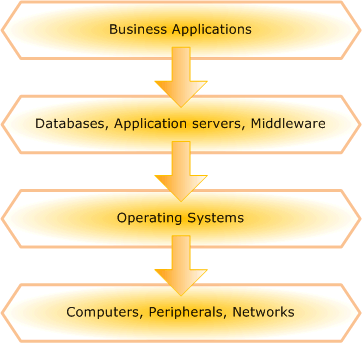
Each stack level offers a number of alternatives and competing suppliers to choose from. But we do not choose between say a cable network and CRM system. It would be foolish to opt for CRM because this is what provides a real value for a salesman while the average user does not care about the network cables and switches.
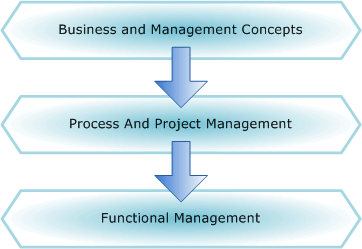
But this is what happens when business and management concepts are considered! Hence I believe it’d be usefull to introduce a notion of Management Competencies Stack. (I use term “competency” rather than “technology” because business and management are more humanitarian than IT.) Here it is:
Some examples:
- customer relationship management, manufacturing planning, budgeting belong to functional management level (they relates to sales, production and finance respectively)
- BPM belongs to the process management level (not to be confused with BPMS which belongs to the middleware level of IT stack)
- Toyota System, Lean, Six Sigma and Theory of Constraints belong to the concepts level
The relationship between the levels here is the same as in IT: the bottom level without the top lacks the target while the top level without bottom lacks supporting technologies.
- Looking top-down, the bottom level is an enabler for the top. This is a gear connecting abstract ideas to specific activities performed by specific people.
- Looking bottom-up, the upper level is what gives a purpose to the activities of the lower level and multiply their impact.
Few examples to illustrate these relationships:
- An ordinary company can’t exist without competencies in sales, production or services (functional level).
- A company which has grown to certain size and level of maturity should put efforts to coordinate activities of functional units within an end-to-end business processes or projects (the process and project management level). Otherwise functional units increasingly work for themselves rather than on the client.
- The value chain theory (concepts level) specifies the purpose for business process initiatives (the process and project management level). Such initiative shouldn’t be only about doing things right, but also about doing the right things.
- Theory of constraints (concepts level) defines a procedure (”five steps”) which helps to pick the most promising business process for your process initiative i.e. the one which will maximise return. Business process initiatives lacking connection to the concepts level come down e.g. to analysis of six levels process hierarchy - a sound excercise indeed but not well rewarded in terms of company’s bottomline.
A lower level of the competence stack is the enabler for upper levels. But does upper levels skills have value in the absence of the lower?
I think yes, yet limited:
- If you try to implement process management in the absence of accounting then your achievements will be limited (if any): you’ll quickly find out that every business process operates with business objects managed by enterprise databases and applications. For example, if you target the “inquiry to order” process without a CRM system then after a while you will find yourself developing your own CRM within the BPM project. (It maybe justified in some cases but be aware that packaged CRM applications will likely be superiour to in-house development.) BPM is mostly for those who have ERP and CRM but aren’t happy with these.
- Lean implementation without competence in process management may be successfull at departmental level but it’ll be hard to extend this methodology to the enterprise level because BPM is the key competency in dealing with cross-functional business processes.
Conclusion: starting from top-level competency may only make sence to gain initial education and experience. Their full power is unleashed only when supporting competencies are presented at the lower level.
Unfortunately the existence of different levels of management competencies and relationship between them is not realized by managers and consultants. I guess this is the background of some dramatic failures.
A likely scenario:
- Assume that Company A has made impressive progress in transforming its business. The information about this success become public.
- Consultants participated in A’s project wrapped up the experience into a new methodology X and started to promote agressively the X and themselves. This is how TQM (Xerox), Lean (Toyota), Six Sigma (Motorola) were invented.
- Company Q decided to use the X methodology and repeat A’s success. Yet the books about X tell little about the necessary Y and Z competencies - mostly because Y and Z are taken for granted at A. Besides, any pre-conditions would have negative impact on sales of X-based services.
- As a result the Q’s project fails. A succeeded and Q failed because A posessed necessary low-level competencies while Q decided not to waste time and take the shortest route to “success”.
Failure to understand the relations between competence levels also leads to wrong assesment of investments effectiveness. For example, it’s widely known BPM projects compare favorably to ERP in terms of ROI. Given that ERP belong to functional competence and BPM belongs to the higher level of process competence, it is not surprising. ERP implementation gives some immediate effect but probably more important is that without ERP you can not benefit from BPM and other skills of the upper levels. Similarly, you can not effectively implement Lean without BPM.
Summing up, here are the promised advices:
- Do not approach full-scale implementation of upper level competency before mastering the lower-level competencies it depends on - the return will not match the expectations.
- Don’t stop after implementing a low-level competency - the most part of the reward comes from implementing top-level competencies that become accessible.
Single-move thinking isn’t enough in business - sometimes you need to plan combinations like in chess. Consider not only material gains (current income) but also the position in the play (acquisition of basic competencies) and the tempo (business agility).
This game isn’t for short-thinking minds indeed. There is also a risk that your successor will harvest after your combination.
Explaining such a combination to shareholders is another tough task. Yet I hope that proposed competense stack is simple yet helpfull for this task.
But probably the toughest question is - what to do if the company has came to the edge already? Well, “Only the paranoid survive.” For others it’s always too early to think forward until suddenly it becomes too late.
If you suddenly found yourself in a swamp fighting with crocodiles you have to think both about the nearest crocodile and draining the swamp.
The following posts consider various aspects of the management competence stack: