
Sorry, this entry is only available in Русский.
Archive for October, 2009
BPM Frontier: Dynamic Processes
BPM conquers the new territory which is called in different ways: Dynamic Processes, Unstructured Processes, Knowledge Worker Processes, Barely Repeatable Processes, Case Management.
BPM now reached the maturity level where the management of repetitive and predictable processes has become a matter of technique. It grants reliable process execution by unreliable employees - low-paid, with low skills and low motivation. Such processes are common for state and semi-state organizations and also for businesses following an extensive path of development.
But only “very talented” individuals can believe that every process can be rigidly structured:

Leaving aside the extremes - fully structured and completely ad-hoc processes - there are two combinations: either a structured process launches the ad-hoc or vice versa.
- “A Little Help From a Friend” pattern: a structured process launches ad-hoc subprocess. An example: system integrator’s “request-to-order” process. Let’s assume that sales rep’s meeting with a client was positive meaning that he found ”pain points” - issues that the client will pay for if they were resolved by the integrator. The next step of the process is finding a solution. However, the client’s problems may vary at very wide range (note that integrator’s value is exactly his ability to solve a wide range of problems) starting from the simplest need of a boxed software to complex projects. In the latter case the process will follow a trajectory unknown in advance that may involve an architect, developer, sales manager, systems engineer, vendor’s tech support etc. Traditional BPMS can only represent this unpredictable subprocess as a single task (see “Process Antipattern: One Man Show“). This is a poor-man’s solution indeed because it isn’t visible who is addressing the issue at the moment, what progress has been made and what the current timeframe is.
- The opposite situation, the “Process Toolset” pattern: unpredictable process at the top launching well-formalized subprocesses. An example: a law firm having client’s case as the top-level process. It’s absolutely impossible to predict in what direction the case will turn next day, e.g. a new document may be submitted by the opposite party that will change radically both the case prospects and our plan for actions. Yet many of the actions initiated within the case are standard, making it possible to formalize each as a subprocess. They are mostly preparing applications or other documents for the court. Such subprocesses is executed by a dedicated specialist - a common resource not assigned to a specific case. From business perspective it’s interesting to monitor performance not only of the case as a whole but also of subprocesses and resources usage.
Going down from the top-level business processes (company’s value chain) to the lowest level (micromanagement) we must be prepared to encounter both structured and ad-hoc process. Support for the latter in today’s BPMS is far behind but this subject is widely discussed by researchers, analysts and vendors:
- The following estimate was made at Gartner’2009 conference: as much as 60% of an organization’s processes are unstructured – and probably also unmonitored, unmanaged, unknown and unruly. These 60% are like “average temperature by the clinic” but the “invisibility” of these processes can indeed be the major issue from business standpoint.
- “Tapping into Collective Knowledge Will Drive Unstructured Process Activity” - Jim Sinur predicts that organizations acceptance of collective knowledge, industry networks and even social networks will result in fundamental changes in BPM. His another post on the same subject: “White-collar and unstructured processes go together like cheese to wine“.
- The boom of social networks pushes the idea to borrow approaches evolved there for communication within dynamic processes - see the Workshop on BPM and social software at BPM conference in Ulm. For example, when confronted with a problem, I can publish the question on the corporate social network (”a help from a friend”). It’s visible to my “friends” including the project manager and team lead. The best answer gets a bonus.
- SAP shows how Google Wave collaboration technology can be used - not for process execution but for modeling. SAP Gravity is a BPMN modeler implemented within Google Wave. Taking into account that the ability to redesign a process on the fly is essential for dynamic process execution, SAP makes progress not only in process modeling and discovery but in the the execution too.
- Oracle talked about collaborative and dynamic BPM at Oracle OpenWorld’2009. They emphasized commitment to SCA that makes possible to combine different kinds of processes with business rules, analytics, etc. That’s no surprise taking into account that they have acquired about 50 companies in two years and hence face huge integration challanges.
- HandySoft, ActionBase and other vendors claim dynamic processes support in the latest versions of their products.
- The most authoritative industry experts gather to discuss dynamic processes in general and their support in BPMN.
So we can see a number of minds attacking the problem from different directions. Well the more alternative approaches, the better final solution should be.
Yet for BPMS vendors that may be a bloody battle. There is probably more BPM vendors than the market needs and now a new front opens for the competition: dynamic processes. It’s quite wide front if all aspects of dynamics are taken into account so I’m afraid not all vendors will be able to fight it in the current economic situation. But at the end of the day those who provided full support to dynamic processes will posess a competitive advantage clearly visible for the users.
Business, War & Chess
Business is like war, war is like chess. Of course any analogy is lame but why not playing with analogies for fun?
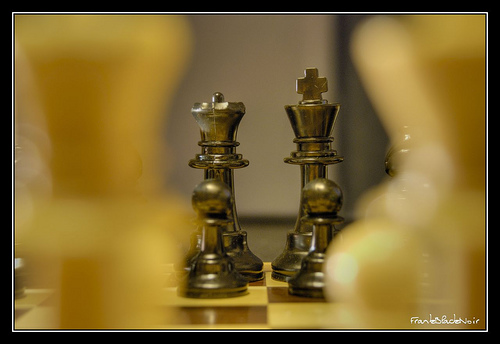
Businessman: we make decision on the basis of a payback or ROI assessment.
Chessplayer: sure one must calculate in advance how much material gains - pawns and figures - may result from a move. We calculate combination too. Yet our game consists not only of combinations. There are forced moves when you calculate rather possible losses than gains. There are moves aimed to pure position improvements. A player may sacrifice a pawn for position improvement. After all if your position does not develop, you won’t have a chance for the attacking combination and ROI would be simply out of question.
Militaryman: we call it getting into a strategic funnel: move after move one has fewer and fewer possible moves that are not leading to defeat.
Businessman: we have company’s strategy too.
Chessplayer: we call it a game plan. Yet in our case the same player build and perform the plan and you calculate win/loss balance after every few moves and depending on the result the chair can take another CEO. It would be interesting to watch your team at the chess board.
Militaryman: a chess game corresponds to the battle or campaign level. A commander may be replaced in the course of the battle only under exceptional circumstances. But a change of command is not uncommon if a war lasts long enough. Business strategy expands beyond the next war so it’s out of our scope, being equivalent rather to geopolitics.
Chessplayer: by the way we calculate not only material gains. There is also a tempo: gaining a tempo means that a player has spent one move less than the opponent. As the result the player gains the initiative: he has many moves to chose from while most of opponent’s moves are forced. Besides there is game’s time limit so we search not the best move but a good enough move that can be found at a shorter time possible.
Militaryman: we calculate the operation’s tempo too. A classical example is mobilization and deployment timings that become the cornerstone of the famous Schlieffen Plan of the German General Staff for the war that was called later First World War. We also know how to drive an enemy under the pressure of chess clock’s flag: by flooding its headquarters with contradictory information and misinformation leave him no time to digest it which eventually leads to complete paralysis of command and control.
Businessman: ok, guess now I’ve got what this “business agility” thing I heard so much is about…
This post continues ”ROI of ERP and BPM” topic. BPM is a speedy, combinational, attacking game while a corporate systems deployment is struggle for the position which alone makes combinational play possible. Or a forced move at bad cases.
(Русский) Семинар 07.10.09: образцовый проект BPM
Sorry, this entry is only available in Русский.