
Very common case: an employee performs the task, his boss checks the work and may return it back for correction. It’s usually modelled like this:
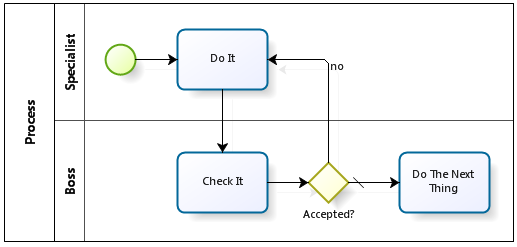
I recommend slightly more sophisticated diagram:
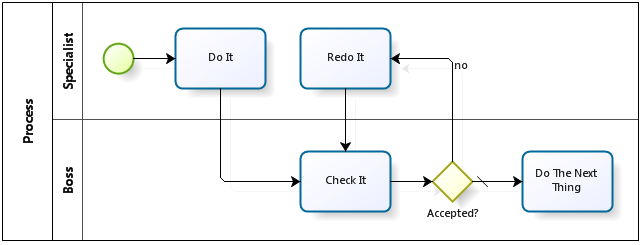
The content of two jobs “Do” and “Redo” may not differ at all, it’s about task names. Now what’s the point:
- Within the first scheme an employee sees a task in his list: “Do It. He does, then presses the button and… after 15 minutes he sees the same task belonging to the same process instance. It’s confusing, especially if he managed to work on some other things during these 15 (or 30, or 130) minutes.
- The second diagram is also better from monitoring perspective: it’s easy to calculate the number of “Redo” executions and the total time spent for them and then focus on bringing them to zero. OK, the number of redo’s can be calculated within the first scheme too - by subtracting the number of process instances from the number of task executions. Yet the total time spent (i.e. unjustified costs) won’t be so easy to calculate within the first scheme.
So that’s the pattern: almost trivial yet (or therefore?) widely applicable.